

HUSAM AHMED SHAFEEQ
There was once a man who recognised truth the moment he saw it. We are all familiar with the story.
He had just reached his hometown after a long journey when he heard the news. His closest friend—the most sincere and sane person he knew—had declared that he was receiving messages from God. The man—whom he had known his entire life as the epitome of truthfulness—had claimed to be a prophet.
These proclamations—considered audacious by the people, who labelled him crazy—were too significant for the friend to ignore. Hence, despite the weariness from travel wanting him to go home, his heart was anxious and would not let him rest until he knew the truth.
“I must ask Muhammad himself”, he thought, heading out to meet his friend.
Making his way through the streets of Mecca, he reached the house of the Holy Prophetsa, and upon admission, inquired if what he heard was true. Fearing that his friend might misunderstand, the Prophetsa intended to explain. But upon repeated demand for a direct answer, the Holy Prophetsa replied that God’s angel had descended upon him with Divine message, appointing him as a prophet unto mankind.
As convinced as someone can possibly be, he responded in a voice that forever set the ultimate standard for the acceptance of truth:
“I bear witness”, he pronounced, “that Muhammad is the Messenger of God”.
This statement was not merely a declaration of faith. It was a transaction of the soul. In that moment, Hazrat Abdullah bin Abi Qahafa, better known as Abu Bakr Siddeeqra, sold his very existence for the cause of this new message—the greatest truth he had ever known. He pledged allegiance to the most truthful of men to ever walk the earth, vowing to never leave his side, come what may. History bears witness that this greatest testifier of truth fulfilled this promise with every atom of his being, never letting his faith waver or devotion falter.
In its journey towards success, truth has always been indebted to the service and devotion of such loyal servants, who accept and support the bearers of truth at a time when they are most vulnerable. Although God’s elect do not seek help from anyone other than the One who sent them, God, out of His sheer wisdom, provides them with such individuals who possess incredibly deep conviction in the veracity of their message and testify to their truthfulness in an unparalleled fashion.
Hazrat Abu Bakrra’s acceptance of Islam is undoubtedly the most remarkable of all such instances that we find in the history of prophets. His account has since served as an inspiration for many to not get swayed by doubt when it comes to recognising truth.
Centuries later
One such instance which was a perfect reflection of the faith demonstrated by Hazrat Abu Bakrra, occurred towards the end of the 19th century, where the spiritual magnetism of a God’s prophet was all a seeker required to recognise truth.
This person—an outstanding scholar himself—had spent years studying Islam, defending the Quran, and safeguarding the honour of the Holy Prophetsa. Yet, against the backdrop of the relentless ideological attacks Islam was facing from all major faiths during that period, no amount of earthly effort was proving adequate to take Islam off the defensive.
That was when he came across the writings of a man from Qadian—unmatched in their arguments and unprecedented in their defence of Islam and the Holy Prophetsa. His words not only provided powerful rebuttals to the overwhelming rhetorical onslaughts of Islam’s opponents but also offered deep insights into the true philosophy and wisdom behind its teachings. Unsurprisingly, his books soon became a source of spiritual nutrition for him.
And then came the news. Or more so, it was a verbal confirmation of what was already obvious. The man who had undertaken the monumental task of re-establishing the supremacy of Islam had now claimed to be appointed by God.
For the seeker, it was a time to testify to the truth that his heart had perhaps whispered to him numerous times.
“I must meet Mirza Ghulam Ahmad Sahib”, he decided and set off for the village of Qadian.
Throughout the journey, his heart remained anxious, and he kept on praying to God. As his cart entered the town, he turned to the driver and asked, “Where is the house of Mirza Sahib?” The driver pointed towards a man sitting on a charpai (a traditional rope bed used across South Asia) and said, “There’s Mirza Sahib”.
And then everything changed for the worse.
All the reverence he had felt throughout this time and all the eagerness to meet the person whose words his soul had been consuming just turned into a deep regret.
The seeker describes his emotions at that moment as an intense feeling of abhorrence that when he saw that person, he wanted to get away from there immediately. The detestable appearance of the heavily bearded man showed no sign of a person who could deliver anything wise, let alone spiritual. It was impossible to even imagine for a second that the author of works such as Barahin-e-Ahmadiyya[1] and the one who had openly invited opponents of Islam to witness its living miracles through him, was this dishevelled person sitting in front of him.
With disbelief on the one hand and disappointment on the other, he turned to the driver and asked him to wait—he would not be staying long. He approached the man, a sense of reluctance creeping through his legs, thinking why he had even come all this way.
Before he could speak anything, the bearded man asked him, “You have probably come to meet Mirza Sahib?”
Suddenly, a wave of relief surged through his body. This was not the Mirza he had come to meet.
“Would you kindly show me Mirza Sahib’s house?” he requested.
The man sent someone to Mirza Sahib, who returned with the message that he could meet him after Asr prayers. With this renewed reassurance, he left from there.
The unkept person he met was in fact Mirza Imamuddin, who was openly hostile towards Islam and would later become a fierce opponent of Mirza Ghulam Ahmadas.
The first meeting
Finally, when the time came, he saw a man descending the steps of the mosque. The moment he laid his eyes on that countenance, the seeker realised he had found what his heart had longed for. With a mixed emotion of admiration and awe, he involuntarily uttered the words that redefined the meaning of faith:
“This is Mirza”, he whispered, “and upon him, I would sacrifice everything”.
Even in that first meeting, there was no unfamiliarity of strangers between them, but the warmth of long-known companions. The spiritual aura surrounding the person was so profound that the more the seeker sat in his presence, the more he felt attracted towards him. Within a few hours, his heart was filled with a firm sense of conviction in his truthfulness.
Hence, before taking leave, he requested Hazrat Mirza Ghulam Ahmadas to accept his oath of allegiance (Bai’at). Hazrat Ahmadas gently replied that he had not yet been Divinely instructed to take Bai’at. Earnestly, the seeker requested that whenever that time arrived, he be granted the honour of being the very first to do so. Hazrat Ahmadas agreed.
And so it happened.
Years later, on 23 March 1889, in a small house in Ludhiana, as a few devoted souls gathered to give their pledge, the very first person to take Bai’at at the hand of Hazrat Ahmadas was the same ardent seeker—Hazrat Al-Haj Maulvi Hakeem Nooruddinra.
From that day forward, his life was no longer his own. Every breath, every action, every possession was now dedicated to this cause—a cause that was prophesied by none other than Prophet Muhammadsa himself.
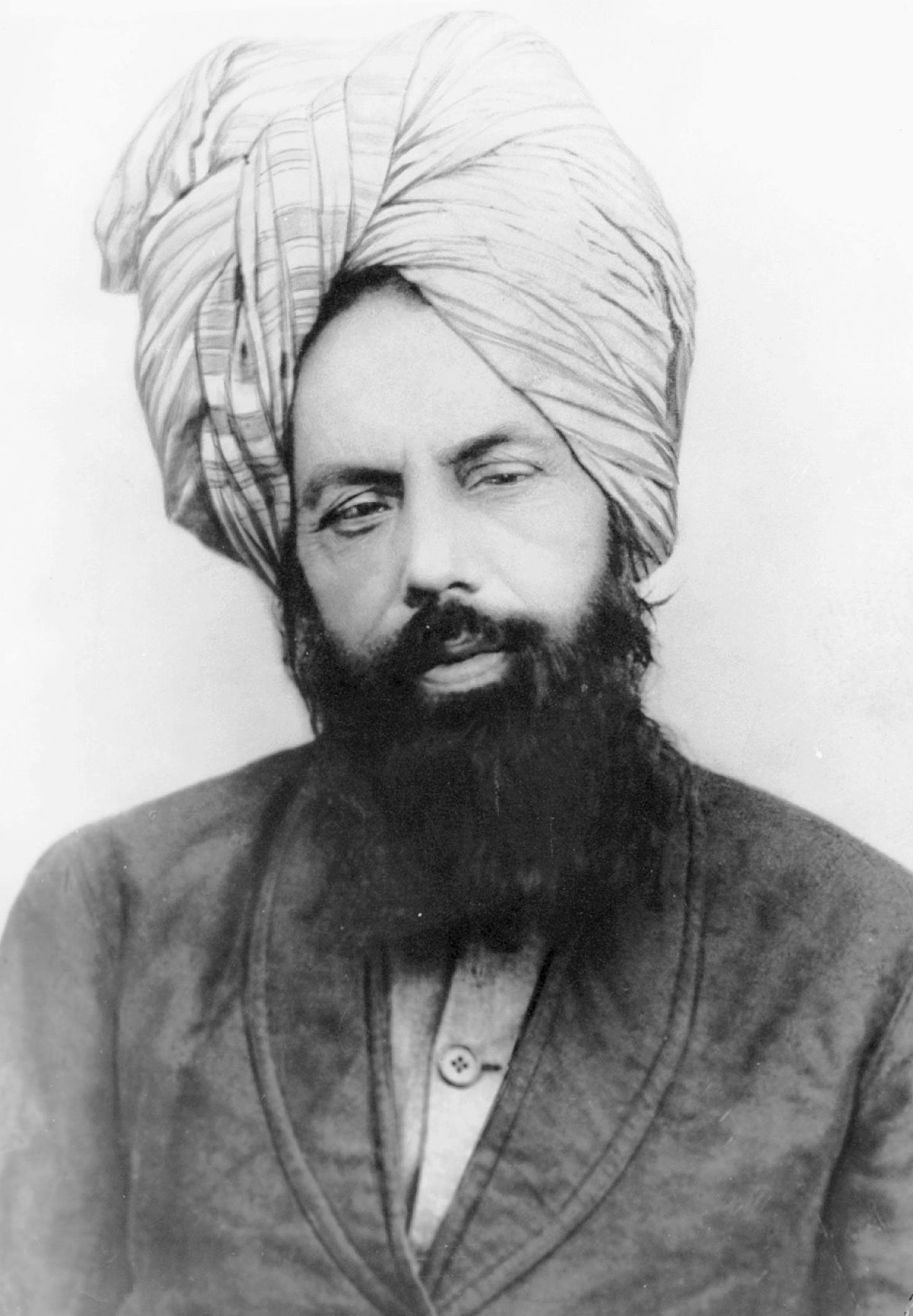
As Hazrat Mirza Ghulam Ahmadas claimed to be the Promised Messiah, whose advent was foretold by the Holy Prophetsa, and undertook the transmundane task of the revival of Islam, Hazrat Nooruddinra remained his most devout disciple and loyal companion, later becoming his First Caliph after his demise.
Despite being a highly popular and revered scholar, he regarded himself as utterly ignorant before Divine wisdom. Though considered a saint by many, he humbly submitted before the Divine light that shone through the Promised Messiahas.
To characterise his devotion as unparalleled would be a severe understatement. To describe him as a perfect embodiment of loyalty to truth may, to onlookers, seem an exaggeration. Nevertheless, Hazrat Ahmadas’s own reverence for him stands as the ultimate seal of testament to his sincerity and faith.
In one of his Persian couplets, the Promised Messiahas sums up the life and character of Hazrat Nooruddinra in the following words:
چہ خوش بودے اگر ہر یک ز امت نور دین بودے
ہمیں بودے اگر ہر دل پر از نورِ یقیں بودے
“How blessed would it be if every member of my Community became Nooruddin,
But it’s only possible if every heart becomes filled with the light of certainty.”
END NOTES
[1] Barahin-e-Ahmadiyya was the magnum opus of Hazrat Ahmadas, in which he openly challenged scholars of all faiths and rational ideologies, presenting arguments compiled in defence of Islam and promising a substantial reward of ten thousand rupees to anyone who could successfully refute them. According to Tarikh-e-Ahmadiyyat (v. 3, p. 100), Hazrat Hakeem Nooruddinra had written to Hazrat Ahmadas and obtained books from him. By that time, Barahin-e-Ahmadiyya had probably been published.









3 Comments
Nasir · November 9, 2025 at 4:26 am
subhannalh. very beautifully depicted.
Muhammad Sadique Dawood · November 9, 2025 at 9:31 am
Two divinely guided souls seperated by millenia however the core takeaway is the same; faith.
KN Mohammad shafeeque · November 9, 2025 at 5:33 pm
‘Tale of Two Testimonies’ – Mashallah, a very unique narrative. I truly enjoyed reading it – simple, precise, and deeply moving.