
IHSAN ALI, QADIAN
Last week, during a session at the ninth edition of the Kerala Literature Festival, the Indian-origin NASA astronaut Sunita Williams was asked whether a scientist should be an atheist—or at best, agnostic.
Sunita William’s reply was powerful:
“I think spirituality and science go hand in hand; I don’t think one deletes the other.”
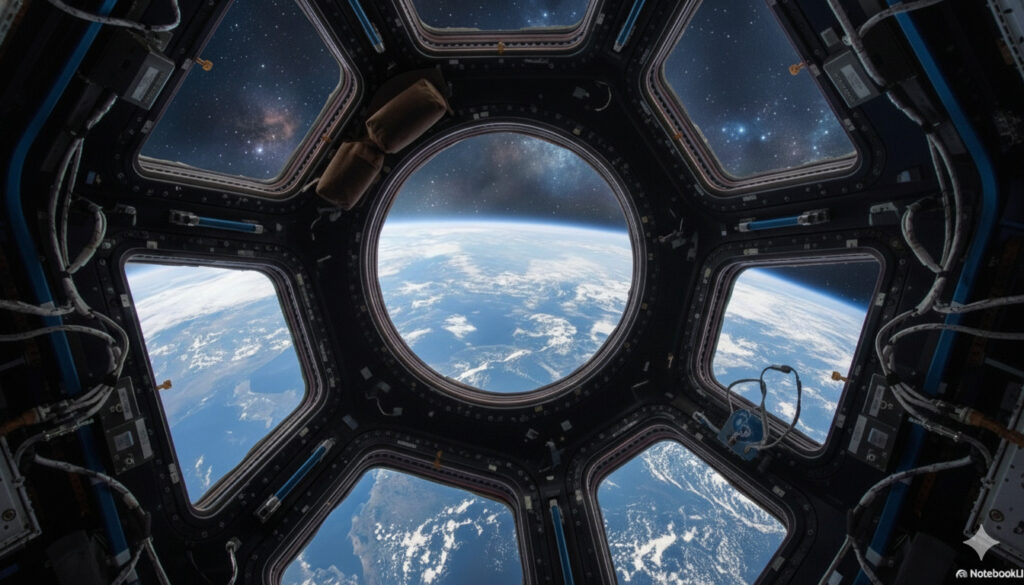
When we go up in space, she added, and look back at the planet inhabiting all the people—each of whom is a miracle in themselves—it makes us wonder how all of this came to be. That understanding, she said, compels us to think there is a greater power that caused all this.
“So I don’t think it’s separate.”
This simple response dispels a dominant myth of our time: that intelligent people tend to reject belief in God. It reaffirms one important fact: that understanding how the universe works does not eliminate the question of why it exists at all.
Do scientists really reject God?
The belief that most scientists are atheists is more cultural propaganda than reality. Dr George Earl Davis, a physicist at the University of Minnesota, writes:
“The popular belief that atheism is more prevalent among scientists than among the unscientific has never been proved and is, in fact, contrary to the impressions gained at first hand by many of the scientists themselves.”[1]
Similarly, Dr H. T. Stetson, Director of the Perkins Observatory, writes:
“Many of the eminent men of science have been devout followers of religion. Among such may be mentioned Galileo, Newton, Faraday, Kelvin and Pasteur.”[2]
These torchbearers of Western enlightenment were not emotional thinkers. They were the people who shaped modern science itself.
Even beyond Europe, Muslim civilisation produced scholars like Al-Biruni, Ibn Sina, Al-Khwarizmi, and Ibn al-Haytham—pioneers in astronomy, medicine, mathematics, optics and many other fields—who saw no conflict between worship and investigation.
Two books, one Author
The confusion between science and religion disappears when their true roles are understood: science studies the universe, while revelation speaks about the Creator of that universe.
To put it simply, science is the work of God, and revelation is the word of God. One explains how things happen; the other explains why they exist.
As such, the Quran never presents itself as a physics or biology textbook. Rather, it provides meaning, purpose, and moral direction. Science, on the other hand, explores matter, energy, laws, and processes.
When each remains within its domain, no contradiction arises.
Truth cannot oppose truth
In his 1926 lecture, Religion and Science, the Second Caliph of the Ahmadiyya Muslim Community, Hazrat Mirza Bashiruddin Mahmud Ahmadra, expounded on this principle very beautifully.
He said that there can be no real conflict between the word of God and the work of God. Any seeming contradiction between them must mean one of the two things: either science is being misunderstood, or religious interpretation is flawed.
For example, people once believed water was a single element, whereas today we know it is a compound of hydrogen and oxygen (H₂O). If any religious scripture had explicitly stated its compound nature, it would have appeared ‘unscientific’ by the standards of knowledge prevailing at that time. In that case, the error would lie with human understanding, not with Divine knowledge.
The Quran encourages scientific thinking
In addition to avoiding discord, Islam also encourages its followers to cultivate scientific inquiry. The Holy Quran repeatedly calls human beings to observe, reflect, and think:
“Say, ‘Ponder over what is (happening) in the heavens and the earth.’”[3]
Here, observing the heavens refers to all fields of science that deal with the study of the universe beyond Earth, including cosmology, astronomy, and related disciplines. Likewise, studying the earth encompasses fields such as geology, geography, biology, as well as history and archaeology, among others.
At another place, the Holy Quran presents the study of the physical world as the hallmark of a true believer and also provides the strongest impetus for man to ponder nature, declaring that nothing in the universe is without purpose:
“Our Lord, Thou hast not created this (universe) in vain.”[4]
Had the Quran feared science as something that could potentially challenge its authenticity, it would never have invited people to explore the natural world. Yet, it not only encourages its followers to investigate the universe, but also emphasises that the deeper one studies the creation, the greater their awareness of the Creator becomes.
Faith is not blindness
It is commonly argued that faith constitutes belief without evidence, and that religions, by urging their followers to have faith, promote intellectual blindness. This, however, is incorrect.
Religions—Islam in particular—do not promote irrational belief. The Quran specifically describes the true servants of God as those who do not believe blindly.[5] It repeatedly exhorts its followers to observe, reflect, and employ rational thought.
The Holy Prophet Muhammadsa actively fought superstition and false beliefs. When his son Ibrahim passed away, and a solar eclipse occurred, people began to claim that even the sun was mourning the Prophet’s loss. The Holy Prophetsa immediately corrected them, explaining that solar and lunar eclipses are natural phenomena and have no connection to human birth or death.[6]
This disproves the misconception that having faith requires one to abandon rational thinking.
Does evolution disprove God?
Some people argue that modern discoveries—especially Darwin’s theory of evolution—have eliminated the need for God. They claim that since human beings developed through natural processes and multiple stages, there is no place left for a Creator in explaining our existence.
This argument, however, is deeply flawed.
Discovering how life evolved does not explain why life exists at all. Tracing the natural causes that underlie life does not nullify the Ultimate Cause that orchestrates those intricate processes. Religion has never denied the existence of causes; rather, it affirms them and places them within a larger coherent framework. While science explains the processes, religion points to the One who set those processes in motion.
For instance, the Quran itself acknowledges gradual development and stages of creation. It does not present human existence as a sudden, magical event but as a carefully guided, step-by-step process. The Quran says:
“And He has created you in (different) forms and (different) conditions.”[7]
Likewise, it states:
“We created you from dust, then from a spermdrop, then from clotted blood, then from a lump of flesh, partly formed and partly unformed, in order that We may make (Our power) manifest to you. And We cause what We will to remain in the wombs for an appointed term; then We bring you forth as babes; then (We rear you) that you may attain to your (age of) full strength.”[8]
These verses show that the Quran is not threatened by the notion that life developed gradually through stages. On the contrary, it presents evolution-like progression as a sign of divine wisdom. The existence of stages does not deny God, but points towards a purposeful Designer who works through law, order, and continuity.
Different domains, no conflict
The idea that faith and intelligence cannot coexist is one of the greatest myths of our time. In truth, there are very few areas of human understanding that should work together as closely as faith and science, because each addresses questions that the other does not.
Science concerns itself with the physical—matter, energy, and measurable reality. Religion deals with the metaphysical—purpose, morality, and life after death. Science reveals the beauty and order of the universe, while religion reveals the very meaning of existence.
To use science to deny God is like pointing to a microscope to dismiss a space observatory. Both are indispensable within their proper domain. One studies creation, the other introduces the Creator. When both are understood correctly, they do not fight; rather, they complete each other.
END NOTES
[1] Scientific Revelations Point to a God, George Earl Davis, from The Evidence of God in an Expanding Universe, p. 70, G. P. Putnam’s Sons, New York (1958)
[2] Man and the Stars, Harlan True Stetson, p. 214, Whittlesey House, New York (1930)
[3] Holy Quran 10:102
[4] Holy Quran 3:192
[5] Holy Quran 25:74
[6] Sahih al-Bukhari, Kitab al-Kusuf (Book on Eclipses)
[7] Holy Quran 71:15
[8] Holy Quran 22:6
Image credit:






2 Comments
Dr Syeda Amtul Jameel Iffath · January 30, 2026 at 5:57 pm
Mashallah Very nice article u have explained very nicely .
Dr. Khurshid Tariq · February 2, 2026 at 3:18 am
Excellent and Eloquent