



















HUSAM AHMED SHAFEEQ
If your greatest strength depends on others’ weaknesses, you’ve already failed.
For most of its history, atheism had remained confined to a marginal demographic, relying mostly on religious criticism rather than on independent intellectual framework. More importantly, it largely appealed to a pleasure-centred worldview, where pursuing endeavours that carry no individual benefit is considered a futile exercise.
As such, we find materialistic traditions such as Epicureanism in Greece, and Charvaka in India that promoted a hedonistic lifestyle, where attainment of pleasure is considered the ultimate goal of human life. Unsurprisingly, scientific inquiry or the study of nature—which demands long-term discipline with no immediate results—cannot become central priorities within such self-centred frameworks.
This lack of purpose is vividly reflected in the historical reality that until the incentivisation of science in the late 18th and early 19th centuries—or when research and inquiry were driven not by monetary rewards but by a desire to unravel the secrets of the universe—atheists were rarely visible in the scientific arena.
For any people of honour, such a legacy of intellectual laziness from their predecessors should be a sign of utter disgrace. Yet, the New Atheists of today quite brazenly gloss over their history of intellectual idleness and shamelessly seek to hijack the heritage of science from the very people of faith who built, preserved and carried it on their shoulders across centuries.
Nevertheless, even this forged certificate of scientific custodianship falls short of providing atheism with enough appeal to engage the intellect of the masses. Hence, they advance another falsehood: that the study of nature inevitably leads to the rejection of God.
While this claim collapses under the weight of its own absurdity, it is further rendered nonsensical by the fact that, across civilisations—from Indian and Greek traditions to the scholars of the Islamic Golden Age—countless scientists and thinkers investigated nature as a direct expression of their belief in God.
But more interestingly, this patently preposterous claim is challenged time and again by those who have had the rare privilege of observing the universe from a perspective experienced by virtually no one else among mankind.
From Neil Armstrong, who spoke of witnessing the “grandest views of the Creator” during his lunar voyage, to James Irwin, who described a deep renewal of faith following his journey to the Moon, and more recently Sunita Williams, who remarked that viewing the world from the vantage point of space compels one to acknowledge an underlying intelligence behind its order—the atheistic propaganda that the study of nature culminates in disbelief continues to be refuted by the most accomplished figures of the scientific enterprise.
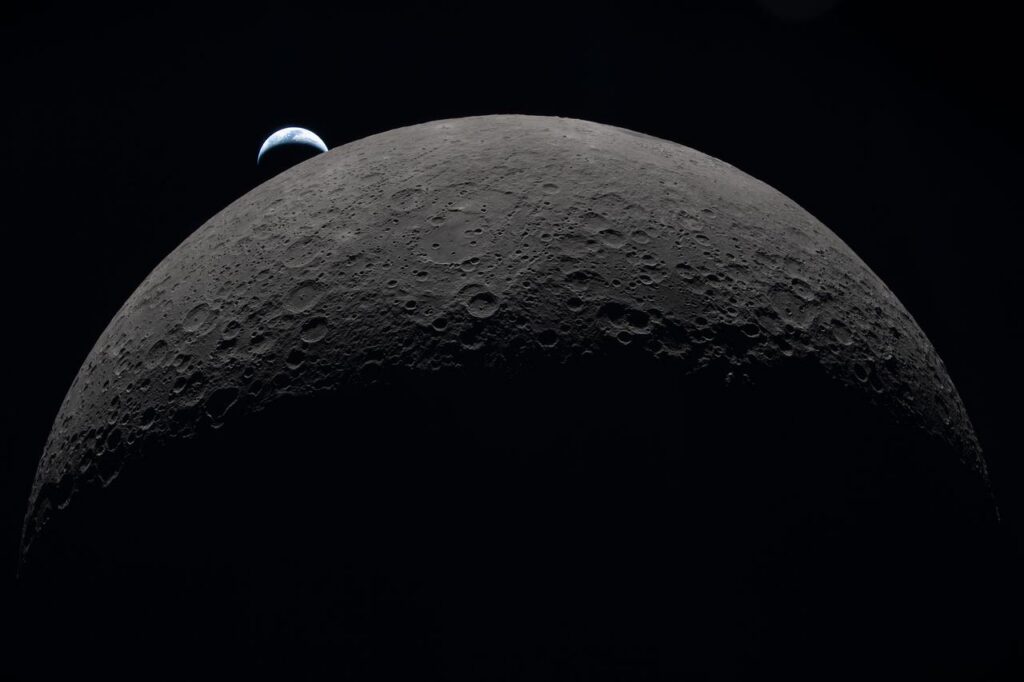
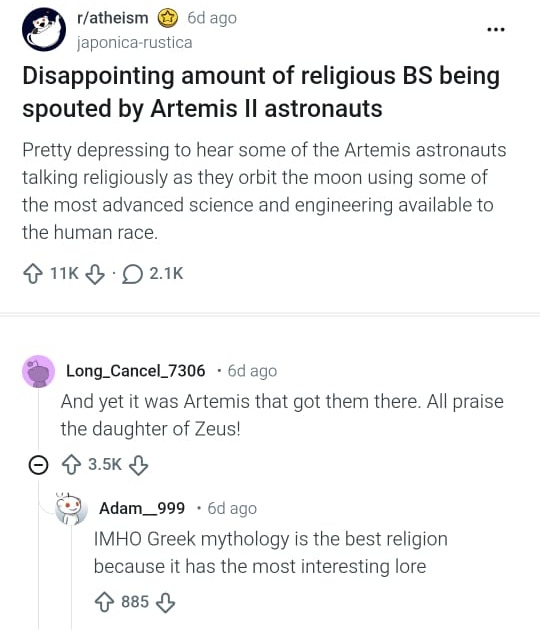
Indeed, it can be very unsettling to get challenged by the very institution one seeks to associate with. Hence, the frustration of atheists at such admissions of faith by prominent members of the scientific community is pretty much understandable. Oftentimes, such frustration is vented in the form of even more fallacious remarks—as seen in the recent commotion surrounding the Artemis II astronaut Victor Glover, who openly spoke of his faith during and after his historic journey around the moon.
As atheists put it, it is oxymoronic—or rather presumptuous—for a person to speak of God while participating in a mission that uses the most advanced technology developed by science. Why—so their infuriated minds ask—do these individuals not place their trust in God instead of science?
Obviously, it is nothing but the folly of their agitated reasoning to assume that belief in God requires one to completely abandon physical means, when it is God Himself who created them. For believers, it is equally unjust to disregard the means arranged by God as it is to ignore God Himself.
In any case, the resentment of atheists is, in a sense, justified—though it is starkly misdirected. It should not be aimed at scientists who simply speak the truth as they know it, but towards the actual source of their unease—the contradictions in their worldview.
END NOTES
[1]
0 Comments