












YAWAR SHAMIM & MOHAMMAD ABASS PADDER
Somewhere in the world right now, a Muslim family is negotiating the price of a goat. Somewhere else, a child is putting on new clothes. And somewhere else still, a cow is being photographed for social media before the prayer has even been offered. Eid al-Adha, the Festival of Sacrifice, arrives each year with tremendous energy and, if we are honest with ourselves, with a growing distance between what we do and why we are supposed to be doing it.
The practice of qurbani is not in question here. The Quran commands it. The Holy Prophet Muhammadsa demonstrated it. Fourteen centuries of Muslims have honoured it. What is in question is the interior condition of the person standing at the altar. And that urgent, uncomfortable, unresolved question is what this article chooses to sit with.
The Quran speaks first: Neither blood nor flesh reaches Allah
Let us begin where we must—with the divine text. Surah Al-Hajj of the Holy Quran states clearly:
“Their flesh reaches not Allah, nor does their blood, but it is your righteousness that reaches Him.”[1]
That word taqwa (righteousness) resists easy translation. It is not simply piety or fear. It is a heightened God-consciousness, the awareness, bone-deep, that you are seen, known, and accountable to Him. It is what a person carries into the act, not what the act itself produces.
Surah As-Saffat presents Ibrahimas in the moment itself: a father with a knife and a son on the ground and a God watching not the blade but the heart.[2] Ibrahimas was not tested on his willingness to obey a dramatic command. He was tested on whether he had already surrendered truly and inwardly to what he loved most. When the answer was yes, he was instructed to sacrifice a ram instead.
The knife had already done its real work, and it never touched Ismailas at all.
This is the Quran’s framework for understanding every qurbani since then. The animal is language. What we are supposed to be saying, through it, is something far harder than writing a cheque.
The Prophet’s standard: The meat was never meant to stay at home
The Holy Prophetsa was not vague about what followed the sacrifice. The meat was meant to move outward, away from the household, towards those who had none. His practice divided the qurbani into three parts: family, neighbours and friends, and the poor. A narration in Sunan Ibn Majah records him saying that for every hair of the sacrificed animal, a reward is given.[3] Scholars have long understood this to speak not only of the act itself but also to its spirit of generosity: the further the blessing travels, the greater the reward.
Consider what this meant in seventh-century Arabia, where protein was a luxury, not a staple. The Prophetsa built a principle of redistribution into the religious calendar itself. He did not frame qurbani as something confined to the Eid table; it was always oriented outward. That principle was never revoked—we have simply stopped honouring it.
Today, in cities where apartments are stacked and freezers are full, it is entirely possible to perform qurbani and have the meat never leave the building. No judgment, only a reminder: the Sunnah was always directed outward. The celebration was always communal. The feast table of the Prophetsa had no guest list; everyone was a guest.
The knife must first find the ego
Hazrat Mirza Ghulam Ahmadas, the Promised Messiah and founder of the Ahmadiyya Muslim Community, offered an interpretation of qurbani that reorients everything else. He described the outward sacrifice as a ‘shadow’, a visible image of an invisible reality that must precede it. He states:
“The outward sacrifice is a shadow of an inward reality; a person must be ready to be slaughtered in the way of Allah before the animal sacrifice reaches its true purpose.”[4]
Before the animal is offered, he taught, the person offering it must have already undergone a kind of inner slaughter: the killing of the nafs (the ego) and the self that clings, grasps, and performs.
This is not a metaphorical softening of a hard commandment. It is the hardest reading of all. It says the qurbani of a man who has not subdued his ego is, spiritually speaking, incomplete.[5] The blood falls, the meat is distributed, the rituals are performed correctly, and yet the shadow has been cast without the substance that gives it shape.
Who among us finds this easy? That is precisely the point. The Promised Messiahas was not describing a high spiritual state reserved for mystics. He was describing the minimum condition for the sacrifice to mean what Allah said it should mean. He was asking, ‘What exactly are you sacrificing?
The mirror of modernity: What “cultural Eid” has done to the festival
It would be dishonest to avoid what Eid al-Adha has become in many communities. The dominant aesthetic today is display. The animal—larger, more expensive, and more impressive than last year’s—is photographed before it is sacrificed. The feast is curated for an audience that will never sit at the table. The new outfit is chosen weeks in advance. And when the day ends, the meat not distributed sits in a freezer for months before it is quietly discarded.
None of this is irredeemable. Culture accumulates around religion; that is natural and not always harmful. But when the culture begins to invert the religion, when the exterior replaces the interior, and when performance substitutes for transformation, something has gone wrong at a foundational level. While the Quran says blood does not reach Allah, we have responded by making the blood more elaborate, more visible, and, in many cases, more Instagrammable.
And the poor? The neighbour? They remain where they were before Eid. Sometimes literally watching from outside.
Universal sympathy: Redefining the festival
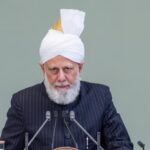
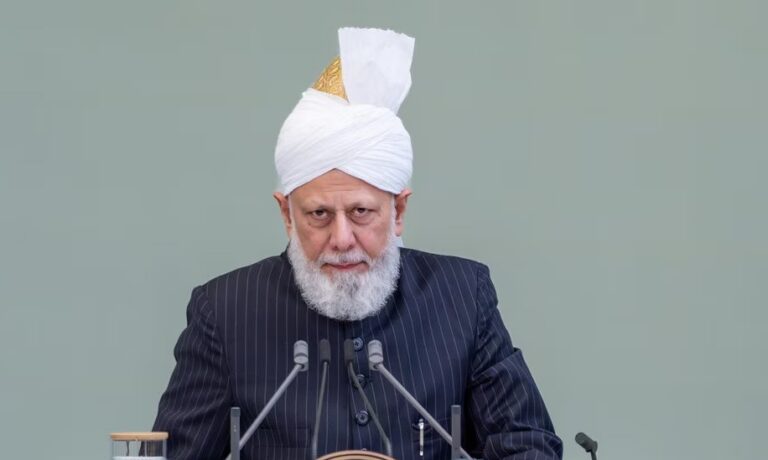
The World Head and the current Caliph of the Ahmadiyya Muslim Community, Hazrat Mirza Masroor Ahmadaba, has returned again and again in his Eid al-Adha sermons to a phrase that carries enormous weight: universal sympathy.
Eid—he has consistently reminded believers—is not a private occasion. Its joy is only authentic when it is shared, when it extends beyond the household, the community and the country and when it reaches people who have no reason to expect it.[6]
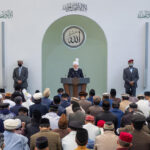
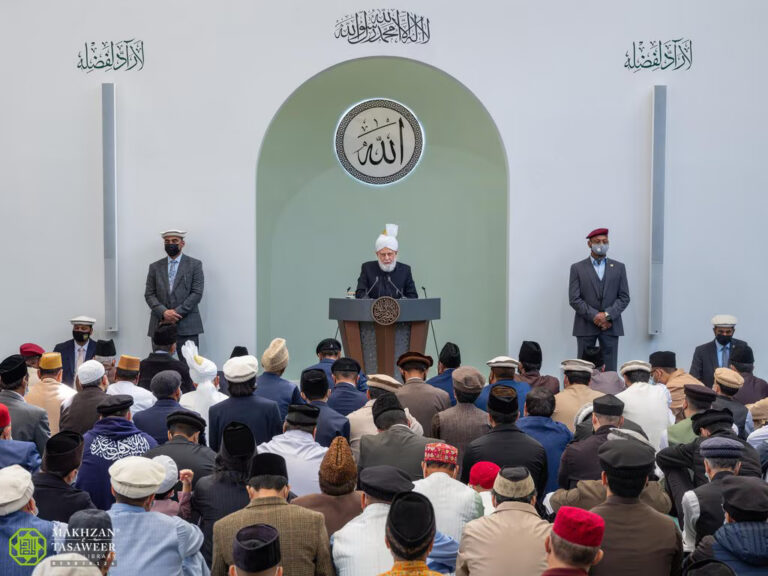
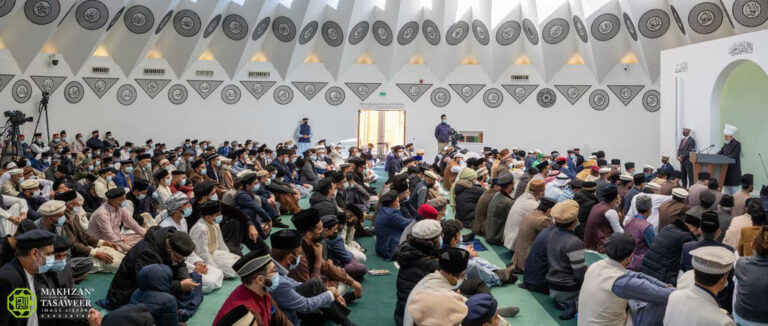
Speaking on 17 June 2024 at the Mubarak Mosque in Islamabad, Tilford, His Holiness addressed those who perform sacrifice without its spirit:
“The spirit of sacrifice becomes overshadowed by their urge to show off as they pursue mere materialistic goals.”[7]
During last year’s Eid al- Adha sermon, he urged every believer worldwide to understand that “true understanding of sacrifice comes when a person recognises that they have one God, one Lord who is deserving of our worship.”[8]
“Just as animals willingly lay down their necks before you, you must also be prepared to bow before Allah and offer every kind of sacrifice to fulfil His commands.”[9]
Under his guidance, qurbani has been transformed, through the institution of Khilafat, into a coordinated global act of hunger relief. Through organisations like Humanity First, sacrificial meat reaches conflict zones, famine-struck regions, and displaced communities across dozens of countries. The three-day festival becomes, in this framework, a year-round discipline, the one day of sacrifice giving shape to a sustained commitment to human dignity.
Ibrahim did not sacrifice once—He lived the sacrifice
Here is what the tradition asks of us, distilled: not a grand gesture once a year, but a posture cultivated every day. Ibrahimas was not called Khalilullah—the intimate friend of Allah—for a single dramatic act on a hillside. That title was earned across a life: fires walked into, families separated, knives raised, and plans surrendered. The sacrifice at Mina was the visible expression of an invisible life already fully given.
Most of us will not face a fire. We will face smaller tests: the choice between comfort and generosity, between visibility and sincerity, between keeping what we have and letting it move toward those who need it. Eid al-Adha is not asking us to be Ibrahimas in the heroic sense. It is asking us to practise, in ordinary daily life, the same directional move: away from the ego, towards God, and through that movement, towards each other.
When Taqwa is what we carry into our work, our wealth, our relationships, and our prayers—not only to the Eid ground—then the sacrifice begins to mean what the Quran says it means. Something rises. It is not smoke. It is not blood. It is the only Taqwa that ever reaches Allah.
END NOTES
[1] Holy Quran 22:38
[2] Holy Quran 37:102–107
[3] Sunan Ibn Majah, Kitab al-Adahi (The Book of Sacrifices)
[4] The Revealed Sermon (translation of Khutbah Ilhamiyyah), p. 7
[5] See The Philosophy of the Teachings of Islam, where the ego (nafs al-ammarah) is discussed as humanity’s principal spiritual adversary.
[6] Eid al-Adha sermon, 27 June 2023, Mubarak Mosque, Islamabad, Tilford, UK
[7] Eid al-Adha sermon, 17 June, 2024, Mubarak Mosque, Islamabad, Tilford, UK
[8] Eid al-Adha sermon, 6 June, 2025, Mubarak Mosque, Islamabad, Tilford, UK
[9] Ibid
1 Comment
NASEERUDEEN HARYANWI · May 28, 2026 at 8:03 am
Absolutely,,,,
It was man and his faith upon his creator
Which was being tested.
المهم صل على محمد و علي ال محمد كما صليت على ابراهيم