














NELOFAR T A & SAYEDA NAYELA
When a director gives full autonomy to fictional characters in his scripted films but completely fails to gauge the autonomy of real women, a glaring contradiction is exposed.
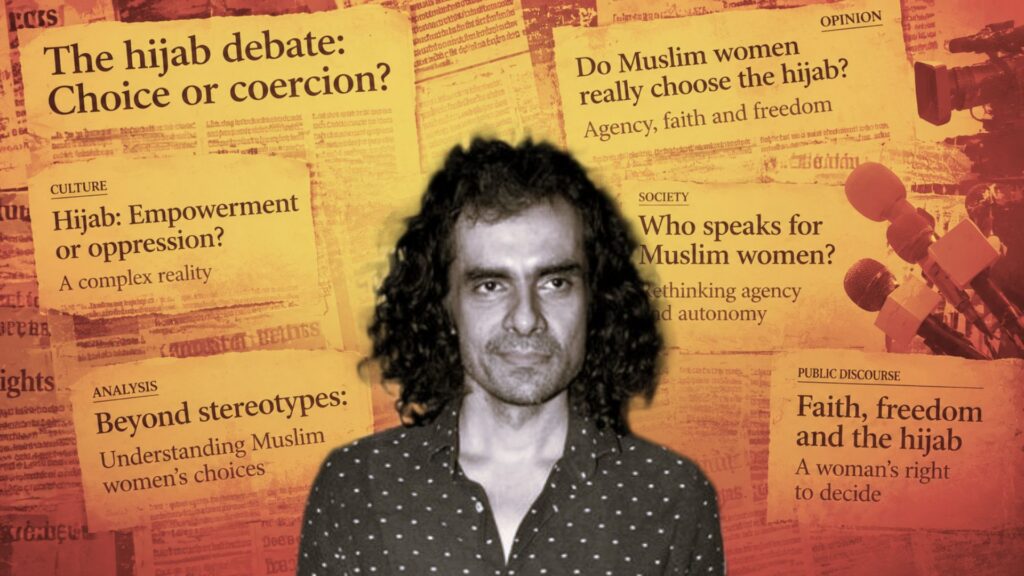
Imtiaz Ali’s recent comments on Muslim women reflect a framework deeply rooted in a place where the male gaze is the norm. He has not only criticised the burqa, but he has entirely taken away the agency from Muslim women.
He says: “I don’t like when someone says ‘I am comfortable in my Burqa. I am comfortable in my parda’. It’s a degenerated society; if you feel like this, it’s not okay. It means that you have become so victimised in your mind, I don’t know how.”[1]
In this framework, a Muslim woman is trapped in a rigid catch-22: if we say we are uncomfortable in a hijab, we are oppressed; if we say we are comfortable, then we have internalised this oppression. So, whatever a Muslim woman chooses, it is labelled as social conditioning, brainwashing, or a victim mentality. The choice itself is delegitimised. It is a denial of everything she says as right, framing all her choices as wrong ones resulting from internalised oppression or marginalisation. Here, the entire autonomy of a Muslim woman is usurped on a whim and placed as wrong in all situations.
It is as though a Muslim woman can make whatever choices she wants, but the moment she wraps herself with a purdah, hijab, or burqa, she is branded as orthodox, oppressed by her family, and victimised internally.
The monolith of the victim
Muslim women continue to be treated as people who need to be saved and liberated, rather than ones who can have choices of their own. When a Muslim woman chooses, her choice too is disregarded as something that has come as a result of internalising oppression over the years. Her vision of the world, the way in which she sees the world, and the way in which she wants to go through it is seldom acknowledged. Instead, it is heavily scrutinised through the lens of liberation feminism or Western saviourism.
The truth is, such views are a direct result of the colonial mindset, for which every “other” is inherently oppressive and barbaric. This constant battle against the hijab is sustained by employing selective feminism and gender politics across mass media and colonial projects.
Consider a study that analysed thirty-five years of reports from The New York Times and The Washington Post. It found that journalists are more likely to report on women living in Muslim and Middle Eastern countries if their rights are usurped, but are more likely to report on women in other societies when their rights are respected.[2] This media bias systematically erases the vast majority of Muslim women who choose the attire out of devotion, resistance, identity, and as a vital part of their culture. Imtiaz Ali has delegitimised these profound choices as degenerate and victimised.
Redefining the gaze and resisting oppression
Muslim women are tired of having to justify their Islamic attire as a personal choice. Ironically, this modest, loose clothing is often criticised as being rooted in a patriarchal framework, while forms of clothing that objectify women in the fashion industry are rarely called out for what they are: a means of satisfying the male gaze.
Oppression comes in many shades. For Muslim women, wearing the burqa to shield themselves from the male gaze is their way of resisting that oppression. This is an act of bravery. They are choosing an attire that clings to their own concept of femininity and allows them to choose themselves, refusing to be a display for hundreds of eyes around them, rather than adhering to the dictums of Western modernity.
What makes a dress oppressive?
The hypocrisy of global fashion policing becomes undeniable when we look at how white, Western spaces handle the very same desire for coverage.
In 2021, the Norwegian women’s handball team chose to wear thigh-length elastic shorts instead of bikini bottoms during their bronze medal match at the Beach Handball EURO.[3] They were actively fined by their federation for refusing to wear the bikini bottoms that are the federation standard. Around the same time, the German women’s Olympic gymnastics team decided to wear full-length unitards instead of traditional, high-cut leotards at the Tokyo Olympics—a move team members explicitly said was meant to combat sexualisation in the sport, highlighting the deep sexism long associated with women’s sports.[4]
According to Akilah Carter-Francique, the executive director for the Institute for the Study of Sport, Society and Social Change at San José State University, it is that individual choice that is so crucial for making athletes feel comfortable in sports. She noted:
“What’s important is that these athletes are allowed to bring their full selves into the space and not have to be concerned about how they look, or whether they are being objectified in these spaces of participation and competition.”[5]
This logic must apply universally. The freedom of a woman is found when she dresses according to her own will. A garment is not inherently oppressive; the denial of choice is what oppresses. Stripping a woman of her voice because her concept of freedom doesn’t look like Western modernity isn’t liberation—it is just another form of control.
Nelofar holds a Master’s degree in Physics. She serves as a sub-editor at Light of Islam.
Sayeda Nayela completed her Bachelor’s degree in Chemistry from Ravenshaw University, Cuttack, and currently serves as an Odisha Administrative Service (OAS) officer. She is a regular contributor for Light of Islam.
END NOTES
[1] Imtiaz Ali Slams Women Who Say They Are ‘Comfortable’ in Burqa and Parda: ‘You Have Become Victimised in Your Mind’, Hindustan Times, 20 June 2026
[2] Islamophobia and Media Portrayals of Muslim Women: A Computational Text Analysis of US News Coverage, Rochelle Terman (2017), International Studies Quarterly
[3] Norwegian Women’s Beach Handball Team Fined for Not Playing in Bikinis, NBC News, 20 July 2021
[4] ‘It’s About Creating Equity.’ The Significance of German Gymnasts’ Full-Length Unitards at the Tokyo Olympics, Time, 24 July 2021
[5] Ibid
6 Comments
Atiyatul Qadir · July 26, 2026 at 2:09 am
Alhumdolillah…..Deep appreciation for your article on purdah in Islam. I truly valued how you balanced historical context with contemporary realities.
Sayeda sammamatun Naser · July 26, 2026 at 4:53 am
Thank you for clarifying such topics
Even I do believe that people out of Muslim culture really love to say that Muslim women are oppressed
Even when we have got all right before 1400 years ago and this people got those rights like 100 years ago and they are teaching us what an oppression means
It’s a clear irony …..
Hijab is meant for women safety and we all are aware of it, and proud of you Nayela and Nilophar for giving such a respectful answer to Imtiaz Ali
Syed Zafar Ahmad · July 29, 2026 at 5:26 pm
The authors deserve appreciation for their lucid and persuasive response to the issue of the veil in Islam. As a matter of fact, the veil or hijab is often misunderstood as a mere dress code, whereas it is essentially a broader principle of modesty, dignity, and moral responsibility that applies to both men and women. Its purpose is not to restrict women but to encourage an environment where individuals are valued for their character, intellect, and conduct rather than physical appearance. When observed in its true spirit and by personal conviction, it serves as a means of preserving self-respect, strengthening family values, and fostering a culture of decency and mutual respect in society.
Naima arif · July 29, 2026 at 5:29 pm
Comments from people cannot define one’s choice or comfort. Such a comment is actually a victimised mentality of people who have never seen a woman work upon her terms and not wanting to be a Slave to someone else’s thoughts. Beautifully presented👏🏻
Sayeda Afsha · August 12, 2026 at 3:52 am
It’s really ironic that those who masquerade as advocates of women’s rights outright refuse to even acknowledge female agency when it comes to Muslim women.
Amazingly replied. MashaAllah!!!
Husam · August 12, 2026 at 4:27 am
Exactly! All slogans of women’s autonomy and agency comes to naught when it comes to Muslim women choosing to dress as she wishes.