















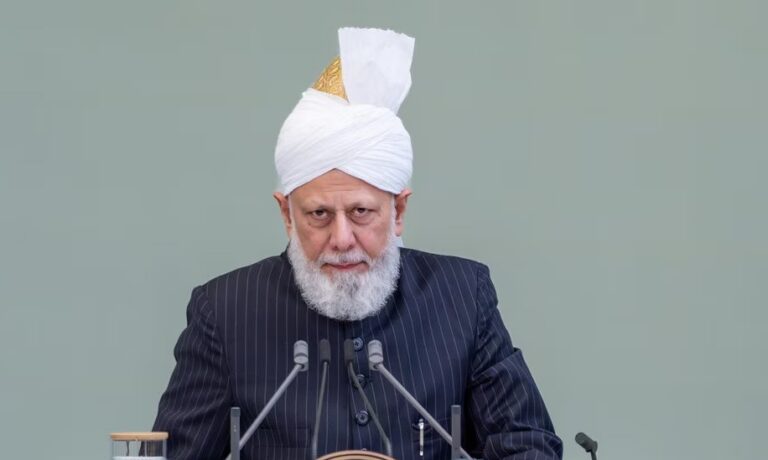



On 6 April 2026, a delegation of Ansarullah (Ahmadiyya Muslim Elders’ Auxiliary) from the Central East Region of the United States had the honour of an in-person meeting with Hazrat Mirza Masroor Ahmadaba, the Worldwide Head and Fifth Khalifa of the Ahmadiyya Muslim Community.
During the mulaqat, the Ansar had the opportunity to present various questions before His Holiness, seeking guidance on a range of matters. A doctor sought guidance regarding the growing use of artificial intelligence in healthcare. He explained that, as an infectious disease specialist, he had encountered many situations in which patients consulted AI and then challenged a doctor’s diagnosis or prescription, even to the extent of questioning whether an antibiotic was correct or needed at all.
His Holiness replied:
The point is that it is doctors themselves who feed artificial intelligence. As an infectious disease doctor, another specialist in the same field might recommend a different medicine for the same condition.
During the time of COVID, people were advised to receive injections and follow certain measures. Some companies produced such injections purely for profit, after which people reacted against them. However, a proper response to that reaction was not provided; rather, it was simply stated that the vaccination was successful for a certain percentage of people, while for others the results were not favourable.
This means that, professionally, since the results were above 70 percent, they were considered promising—and “promising” is taken to mean successful. However, it is the 30 percent that makes more noise. The 70 percent who were cured do not make a fuss. Furthermore, within the medical profession itself, there were doctors who disagreed.
As for artificial intelligence, this is not something unique. In the matter of religion, for example, we had a question presented to AI to see its response. It cited a Hadith and gave an answer accordingly. Then the questioner—one of our Ahmadis, whom I had instructed—said, “Your answer is wrong; the actual Hadith goes against it.” The AI replied, “Yes, you are right, my answer was wrong.” Thus, AI itself admitted its mistake.
The same applies to AI in the medical profession as well. It cannot be relied upon completely, nor can it be fully trusted. AI does not have a mind of its own; it is the human mind working behind it. It produces answers based on what has been fed into it, or it compiles various views and presents a consolidated result.

Therefore, people should be advised not to rely too heavily on AI. It should be explained to them that they are being examined and that their condition is diagnosed based on tests. Doctors today rely heavily on laboratory tests—blood tests, urine tests, MRIs, scans, and so on.
In contrast, earlier doctors treated patients by closely observing symptoms. For example, Dr Hazrat Mir Ismail Sahibra was a gynaecologist, general surgeon, orthopaedic surgeon, and ENT specialist, and he managed all kinds of cases. Similarly, it is said of Hazrat Khalifatul Masih Ira that he could diagnose illness simply by checking the pulse.
In contemporary practice, doctors rely more on laboratories. Therefore, it should be explained to patients that laboratory tests indicate their condition and, based on these results, treatment is recommended, and that AI may be incorrect as it does not have access to all those test results.
People nowadays also find reassurance in tests. Even when a doctor examines them carefully or uses a stethoscope, it has a reassuring effect.
There was a lady in Rabwah who became quite ill. She was seen by Dr Mirza Munawar Ahmad Sahib, for whom she worked at home. He checked her blood pressure and gave her some medicine. The next day, she said, “Mian Sahib, give me the same injection you gave me yesterday”, even though no injection had been given—only her blood pressure had been checked. This illustrates a psychological effect.
If a patient is examined properly and given medicine, they are likely to feel satisfied. As for AI, patients should be made to understand that it may be mistaken, and it should be explained, “I am examining you carefully”. When one listens attentively to a patient’s concerns, they are already 50 percent reassured. AI cannot provide that reassurance.
Of course, there will always be some people who strongly believe in AI. Even when a doctor prescribes medicine—for instance, when I am given medication—I sometimes read the leaflet first. Pharmaceutical companies list many possible side effects to protect themselves. If a patient focuses on these, they may refrain from taking the medicine altogether.
0 Comments