










THARIQ ABDULKALAM, PALAKKAD
Islam does not present animal sacrifice as an act of cruelty, nor as a ritual through which God is pleased by bloodshed. Establishing its clear purpose, the Holy Quran states:
“Their flesh reaches not Allah, nor does their blood, but it is your righteousness that reaches Him. Thus has He subjected them to you, that you may glorify Allah for His guiding you. And give glad tidings to those who do good.”[1]
This verse forms the foundation of the Islamic understanding of sacrifice.
A story of obedience and sacrifice
The historical origins of Eid al-Adha trace back to the Prophet Abraham (Ibrahimas), his wife Hagar (Hajirahas), and their son Ishmael (Ismailas). According to the Holy Quran, Abrahamas saw in a vision that he was sacrificing his son. Upon hearing his father’s dream, Ishmaelas replied:
“O my father, do as thou art commanded; thou wilt find me, if Allah please, steadfast (in my faith).”[2]
When Abrahamas was about to place the knife upon the neck of his beloved son, he was commanded to stop and sacrifice a lamb instead. Through his immediate and unconditional readiness to sacrifice his son, Hazrat Abrahamas set a profound example of complete submission to the will of God. In commemoration of this extraordinary act of devotion and submission, Muslims across the world perform the ritual of sacrifice during Eid al-Adha, the tenth day of the Islamic month of Dhul-Hijja.
Though many portray the story of Abrahamas as the beginning of centuries of animal slaughter, it was in fact the command from God to abolish the custom of human sacrifice that existed among ancient peoples.
Qurbani and the purpose of sacrifice
The word qurbani originates from the Arabic root قرب (qurb), which means ‘nearness’ or ‘closeness’[3]. The terms qurban, qurbani and udhiyah are used for the animals sacrificed during Eid al-Adha, but embed the philosophy that sacrifice is intended as a means of drawing nearness to God. Drawing a parallel to this outward act of sacrifice, the Founder of the Ahmadiyya Muslim Community, the Promised Messiahas states:
“A Muslim is one who submits himself to slaughter before Allah, the Lord of all the worlds and who, for His sake, has slaughtered the she-camel of his self and has thrown it down on its forehead.”[4]
But, if God desires righteousness rather than blood, why preserve the physical ritual of sacrifice at all?
Islam does not view spirituality as an abstract internal state disconnected from the physical one. Rather, physical actions are seen as a means of cultivating spiritual conditions within man. Prayer involves bodily humility; fasting disciplines physical desire. Similarly, physical sacrifice is a bodily reminder to the soul about the importance of the sacrifice of self towards the pleasure of God.
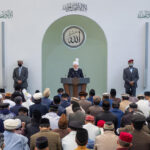
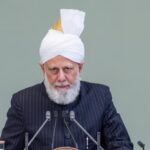
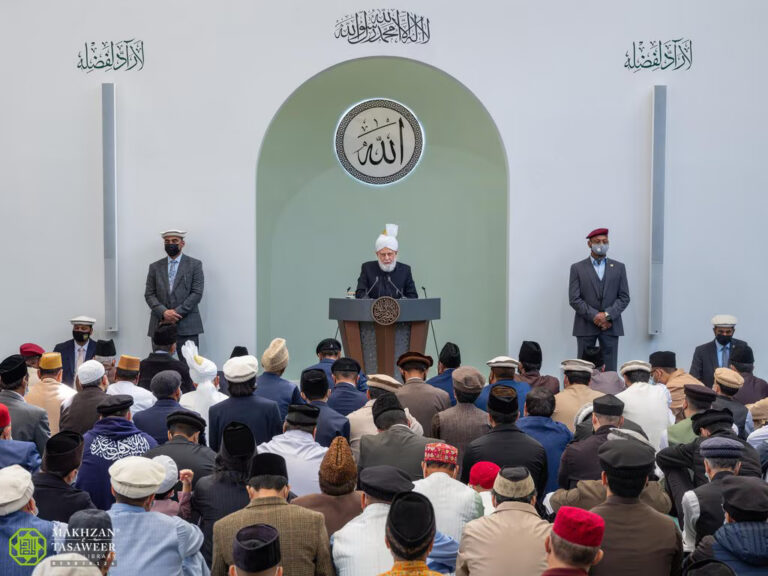
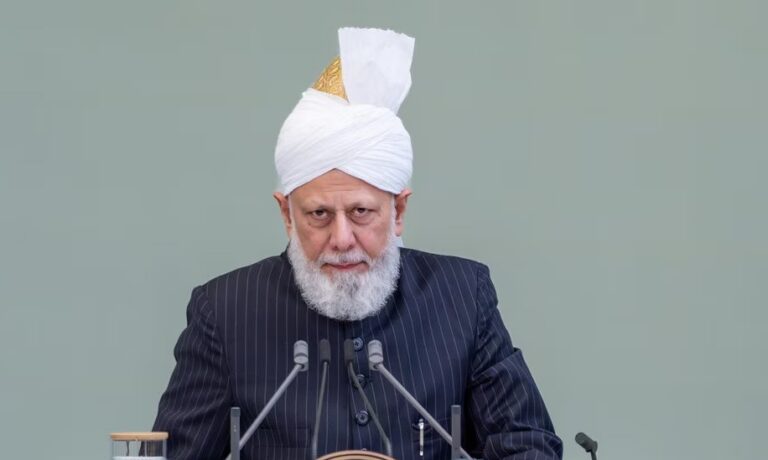
Quoting the Promised Messiahas, the current Worldwide Head of Ahmadiyya Muslim Community, Hazrat Mirza Masroor Ahmadaba says:
“The Promised Messiahas said that those who do not use their physical capacities, then the spirit is not impacted, for there is a connection between the physical and spiritual. Thus, physical actions have an impact on the spirit. In the same token, if a physical action is carried out without any spirit behind it, then that is dangerous and amounts to nothing.”[5]
This also removes the misconception that the sacrificed animal somehow atones for human sin. Islam teaches that no person or creature can bear the sins of another, nor can the blood of any being serve as atonement for the sins of others.
Sacrifice with purpose
Most people who oppose animal sacrifice raise the issue of cruelty towards animals. Yet human civilisation itself has always functioned within a broader food cycle in which animals serve as a source of nourishment for mankind. Specifically, animal-based protein has served as one of the richest and most complete sources of protein for human beings, containing essential amino acids in highly bioavailable forms.[6]
Thus, far from being unnatural, eating animals is simply to act in accordance with the order of creation. The Holy Quran says:
“And He has subjected to you whatsoever is in the heavens and whatsoever is in the earth: all (this is) from Him.”[7]
Slaughtering for fun or mere spectacle, however, is not permitted and is wrong. Islam prohibits all forms of animal sacrifice that do not involve the consumption of the meat afterwards, and does not encourage wastage of any kind. Regarding wasting food, it says:
“Eat and drink but exceed not the bounds.”[8]
Moreover, the meat of sacrificed animals is distributed among family members, neighbours, and especially the poor and needy, serving a greater social purpose.
True spirit of sacrifice
While the Promised Messiahas has always emphasised the obligatory nature of sacrifice and distinguished it from financial sacrifice, he also made clear that it must be offered well within the financial capabilities of a person. While answering a written enquiry, the Promised Messiahas wrote:
“Contribution to the Poor Fund does not constitute a sacrifice. If the amount is sufficient enough for purchasing a goat or a ram, you may slaughter one. But if it is insufficient then it is not obligatory on you to offer a sacrifice.”[9]
In the present day, there are other limitations imposed upon sacrifice due to religious and political tensions. In Pakistan, radical clerics often hinder Ahmadis from offering sacrifice every year and take pride in such shameful acts. The current Worldwide Head of the Ahmadiyya Muslim Community has stated that this behaviour stems from a lack of righteousness within themselves. He added that if one is unable to offer a sacrifice, there are other forms of worship through which righteousness can reach Allah:
“We should not be bothered by being stopped from carrying out the sacrifice. If we had intended to do so and our intention was made with righteousness, then we need not worry, for this will be accepted in the sight of God.”[10]
This is the true philosophy of sacrifice in Islam. The Promised Messiahas encapsulates this principle beautifully in one of his Urdu couplets:
اسلام چیز کیا ہے خدا کے لئے فنا
ترکِ رضائے خویش پئے مرضیٔ خدا
“What is Islam? Self-annihilation for the sake of God;
to relinquish one’s own desire for the pleasure of God.” [11]
Thariq holds a master’s degree in physics from Chandigarh University and is currently pursuing a second master’s degree in Quantum Information Science and Technology from TU Wien (Technical University of Vienna). He is a regular contributor for Light of Islam.
END NOTES
[1] Holy Quran 22:38
[2] Holy Quran 37:103
[3] Lane’s Lexicon, under qaruba
[4] The Revealed Sermon (khutbah Ilhamiya), p. 7
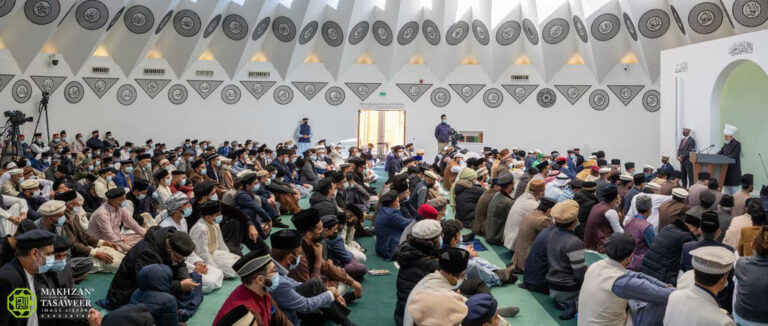
[5] Eid al-Adha Sermon, 21 July 2021, Mubarak Mosque, Islamabad, Tilford, UK
[6] Dietary Protein Quality Evaluation in Human Nutrition, an FAO expert consultation report (2011), FAO Food and Nutrition Paper No. 92
[7] Holy Quran 45:14
[8] Holy Quran 7:32
[9] Badr weekly, 14 February 1907, p. 8
[10] Eid al-Adha Sermon, 21 July 2021, Mubarak Mosque, Islamabad, Tilford, UK
[11] Barahin-e-Ahmadiyya Part V, p. 26
0 Comments