ARTICLES

Why would a good God allow suffering? If He is all-powerful and all-merciful, why does He not rid the world of misery? Isn’t a truly painless world the paradise we long for—or would such a reality, paradoxically, be nightmarish?
It is commonly argued that science and faith cannot coexist. However, some of the greatest scientific minds—those who have viewed the world from a vantage point experienced by only a handful in human history—beg to differ.
As enthusiasm fades and routines falter, consistency becomes the key to staying aligned with our goals and turning intention into lasting progress.
Those who accept beliefs without investigation follow error and hearsay, whereas true believers base their faith on proof, reasoning and certain knowledge.
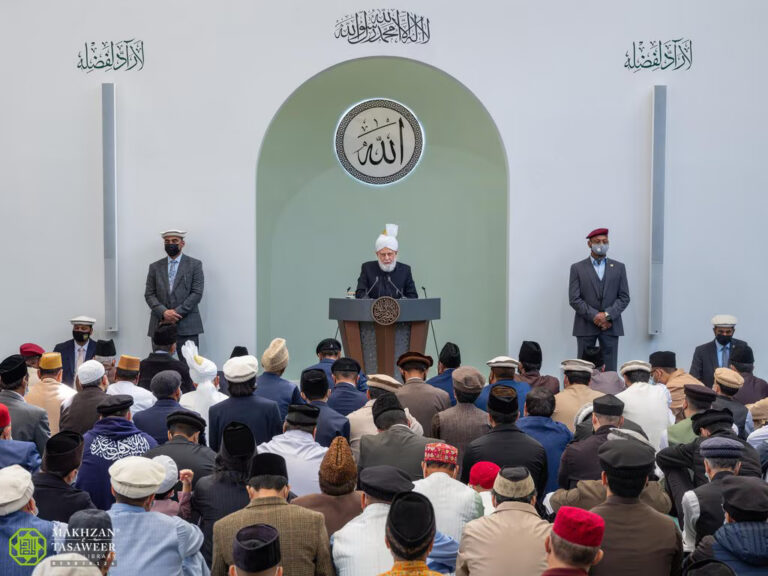
As the new year begins, the Ahmadiyya Caliph appeals for prayers for the progress of the Community, the release of imprisoned Ahmadis, the deliverance of oppressed people worldwide, and the establishment of peace across the globe.
Across history, there have been many attempts to end slavery. Yet, all too often, emancipation came at the cost of human lives or remained confined to paper, thus falling short of securing true human dignity.
The Ahmadiyya Khalifa addresses the Annual Convention in Qadian, outlining the need to practically fulfil the conditions of the pledge of allegiance to the Promised Messiah(as).
Does the Quran truly foretell universal truths? Or does it merely echo scientific discoveries? Recent advances in cosmology show that the Quran accurately predicts many phenomena that are centuries ahead of its time.
From keys to phones to wealth and fame, human beings always tend to search for things in the wrong places—peace being no exception. Often, one simply forgets that true contentment can come only from the One who created it.
In a world where modern efforts often fail to resolve conflicts, the Treaty of Hudaybiya, concluded fourteen centuries ago, offers timeless lessons in diplomacy, patience, and principled leadership.
Depression has been called the world’s number one public mental health problem. It is an illness that mostly results from thoughts that are distorted in some way. Fortunately, you don't have to live with depression; you can always show it a way out.
History provides us with enough evidence on how racism – a baseless notion of one's own race being superior to others – can infect a person's mind and preclude any attempt to understand its victims.
Do we need God in the 21st century? What role can religion play today in creating a moral society? Is not the concept of God and religion superfluous in this era of human development?
There are many precautions and safety measures governments are making their subjects to observe so as to tackle the pandemic of COVID-19. But has anyone cared to turn towards the Creator of mankind, Who has been forgotten as if He does not even exist?
The real objective of Ramadan is to make man capable of fulfilling the very purpose of his creation – i.e. to attain the nearness of God.
For over a month under lockdown, people have forgone many of their social rituals and traditions. However, Muslims had no difficulty observing their religious obligations, even confined in their homes.
One does not become the recipient of bounties by merely observing the fast in Ramadan. Instead, it is essential for a person to fulfil its requisites and focus on good deeds.
Islam has often been accused of being a threat to Western culture and civilisation. However, given the Judeo-Christian roots of Western culture, it is actually atheism, not Islam, which threatens to destroy that culture.
World leaders must work towards ensuring that the world we leave behind for our children is marked by peace and prosperity, not a world of crippled economy and malformed children.
While atheists try to disprove God referring to the closure of houses of worship amid Covid-19 concerns, a simple analysis of their claims exposes the flaws in their 'logic' and lies in their 'facts'.